Whose Madras?
A contemplation on and for Chennai city on 'Madras Day'.

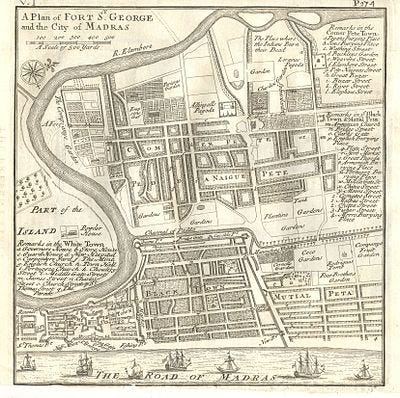
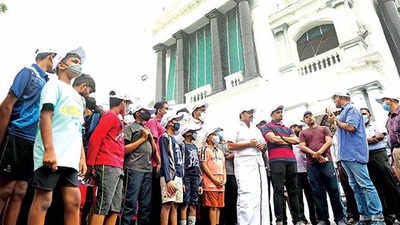
Today is Madras Day. Beginning in the late1990s, we are told it was an event to celebrate the founding of the British city on one day. Over the 2000s it started to pick up steam and events began to grow. By the time I began to immerse myself in the mid-2010s, it was about two weeks long and involved primarily heritage walks, but also a few exhibitions, competitions, some food walks and talks on the city’s history. It grew at a phenomenal rate and by the time Covid hit in 2020, it was promising a month long set of events, beginning in the last weekend of July and ending in the first week of September. In short - we just could not get enough.
But who celebrates, and what Madras?
Thats a pretty standard answer, you might reply, reading this. Of course its not completely inclusive, these city celebrations are typically for those with leisure time: the upper middle class.
The idea of the Madras Day was not meant to be some socially unifying celebration at first, but one that created an awareness. S Muthiah, who is regularly credited as being the one who pushed for Madras Day year after year and used his platform, Madras Musings to promote it, was deeply interested in the city’s history. And his readers from the newspapers and the Madras Musings magazine were of that milieu, those who had time for heritage walks on the weekends, early in the morning, read and lived English, and had an interest in colonial history. They were also the ones who first took up the spread of Madras Day activities.
Yeah, of course, you interject. Who doesnt love the city? especially when its a city like this one, with so much to boast about? So many firsts, so much activity, happenings, such interesting history, such a key piece of territory for so much colonial development: forget the class angle, at least its free! Imagine, paying 700 rupees to someone to tell you this stuff. That would be ridiculous. (You might want to hold on about your assumptions there. Its not the 90s any more my friend :) neoliberalism is not some new idea in Delhi any more).
So, like I asked before, what Madras was this? The Madras that got so much importance and a day to itself was, ironically, Day’s Madras. Francis Day, who along with a couple of other British officers, signed a treaty with the Raja of Venkatagiri - and of course the Dubash’s who were there as well, who get a passing mention at best. And so it went, with the British city being the centre of all heritage and history related activity at first. From Day and co in 1639, to Yale and co in the 1680s , to the seige of Madras and the French occupation in the 1740s, the ‘wonder-years’ of the 1800s when history just grew out of every pavement with the city’s own growth, and of course the 20th century when finally the National movement made a commendable mention appearance in the 20th century narrative of the city’s history.
Its a colonial city da, don’t expect much else please. And what about pre-colonial? It did exist too, you know!
Fair enough. And things are changing, the history of the whole 20th century does feature. But lets not forget all the temples! All those pre-colonial temples that historians will fawn over (especially their iconography) and debate, while sometimes forgetting that they too have context.
Hold on -
Do you see what I’m pointing to? The gaps were large - and its only recently that people have been coming in to fill them, expand the understanding of what Madras had, and did. The story of those who were oppressed, who disliked the city, who lived precarious lives. The pre-colonial city, and the city outside the British garden. Where is the story of the ‘cheri’s’, still largely untold but very very prominent in the city’s landscape today?
This is of course largely to do with who was getting involved. But like you said, it was free. And another bonus, it was at the citizen level - there was only organisations supporting it, not organising themselves. Individuals really wanted to bring people into the city’s history and so they spread the word and those who heard the word were fans of the movement - the Madras Day movement.
But of course, these individuals are not without their own failings. What makes Madras Day is that year on year they commit themselves to the city’s history and like so much else in this city to this day, perform a role that is not driven by money. That is beginning to change. Some individuals had capitalised on the heritage market years earlier and began to raise their prices till it was not just an internal feeling but an actual barrier to those whose histories were being ignored from hearing about it and joining in. Just prior to the 2020 lockdown, that picked up with organisations joining the space, monetising it. On the other hand, another change is that we have begun to accept non-elite history narrations in our Madras Day. It was a long time coming, but the efforts of some are paying off, to make history an accessible realm, to really understand the city you live in.
Hey Nandan, you jump in, whats wrong with making a few extra bucks on the whole thing? And another thing, aren’t more ‘groups’, rather than individuals driving Madras Day post-covid?
Absolutely, but the point is that this should not be about the money. History once capitalised on, will just become about what makes money more and the audience behind it - and so we return to a British and Brahmin history of Madras, one that, in recent years we had begun to merge with the real ‘city history’, where it was just one component. About the groups, to a large extent, this is a product of Madras Day having pulled in a gathering. This year The Hindu has practically taken over the space with advertisement of themselves and organising their own events that hold virtual space but limit the actual audience, one which has, as I have been writing, been typically individual driven.
Whats the solution? I don’t know. Life is complicated and societal relations are especially so. Not crowding or capitalising on a movement takes strength and willpower, one that those running it need to be able to demonstrate — to give space, and at the same time to stand up to those trying to take too much of it for themselves.
Today, August 22nd is officially marked Madras day on many many calendars. A celebration of a city that millions call home - not a carnival, nor is it academic conferences, but something that balances between the two and calls for people to bring themselves to the city. I have been a part of this city since birth and have involved myself in these celebrations for a significant few years - in fact Madras history could even be called my draw into the world of history as a discipline. So yes, i have a deep fondness for this city and our Madras Week/Month as it has become.
Where am I going with this? I don’t know. These are some thoughts I have had, perhaps cohesive, perhaps confused, a segment of a young mind trying to make sense of his city and its actors. I do believe that conversation, which Chennai fosters in riverfuls, is what we must definitely keep going. And so, I welcome your thoughts to my own.
Images source:
https://franpritchett.com/00maplinks/mughal/mollmaps/madras1726/madras1726.html
https://timesofindia.indiatimes.com/city/chennai/heritage-walks-could-soon-cover-chennais-treasures/articleshow/86545597.cms?from=mdr
Very interesting read. And points that have certainly been rattling inside many of our heads.... Thank you for articulating. In some ways as movements like Nam Veedu Nam Oor Nam Kadhai are starting to bring out the histories of the common people and less privileged parts of the city, the trend for big names to usurp the event and turn it into a PR opportunity for themselves is concerning. The true "original" people of the region of Madras are the fisherfolk, and it would be great if they were involved in the telling of their stories too. Hopefully soon. In being a city that welcome everyone, we shouldn't become a city that isn't for the original inhabitants.