Seizing the commons
A brief thinking-through of the loss of shared space in cities

This whole piece is not the best put-together, but it is one I have been sitting on for too long, and one that I have been thinking about for a while as well
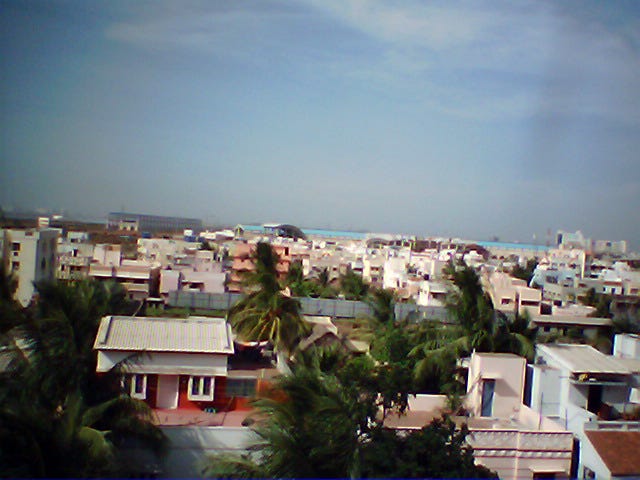
This story begins on an MTC bus, and a view. On an everyday level, the views of the city are best experienced from an MTC bus. You see the road, you see the sides, and you lord it over everyone else.
As my bus turned the corner from the Adayar bridge toward Quibble island, a passenger sitting behind me looked out in disappointment. Large construction site cranes loomed above, and gaping holes into the ground opened by the side of the road. Look at the public area that’s disappeared for this work, she complained. The person she was traveling with said a few words in agreement, as we very quickly passed by. This large construction area was one I was familiar with, having seen it as a park from the bus for years. In its place is the beginnings of an underground metro station.
Like in the cover picture, getting a vantage view of a city and its growth is hard. Seeing all the parts that make it what it is. But whether it is the nominal height advantage of a bus window, or the super-suspended multi-story building, open unbuilt spaces stand out. And these spaces are important to the city not just as gaps.
Metro travel is cheap, convenient and allows people to get from one part of a city to another without having to deal with the hassle of traffic. However, in order to build those metro stations, there is a price that the city pays - the most common is in the loss of the ‘commons’.
Ok wait, what is this term commons? What does it mean exactly? Commons were areas in England jointly farmed, which were divided up in the 17th and 18th century with the advent of industrialisation and migration of working populations to cities. A lot has been written about ‘the tragedy of the commons’ which is used to describe overpopulation and the overuse of the commons space. My take is different. I want to look at the way commons have been taken away, not by the users themselves, but by the state. And so, have been seized. The common spaces of the modern world are being eaten up by activity that generates money - economic activity. Parks, open public spaces, water bodies, and unused land are eaten by metro rail, construction, and other works that are seen as ‘economically’ more viable. I will be thinking about this through Chennai, as it is the city I know best, but can be applied in a broadly similar way to other cities.
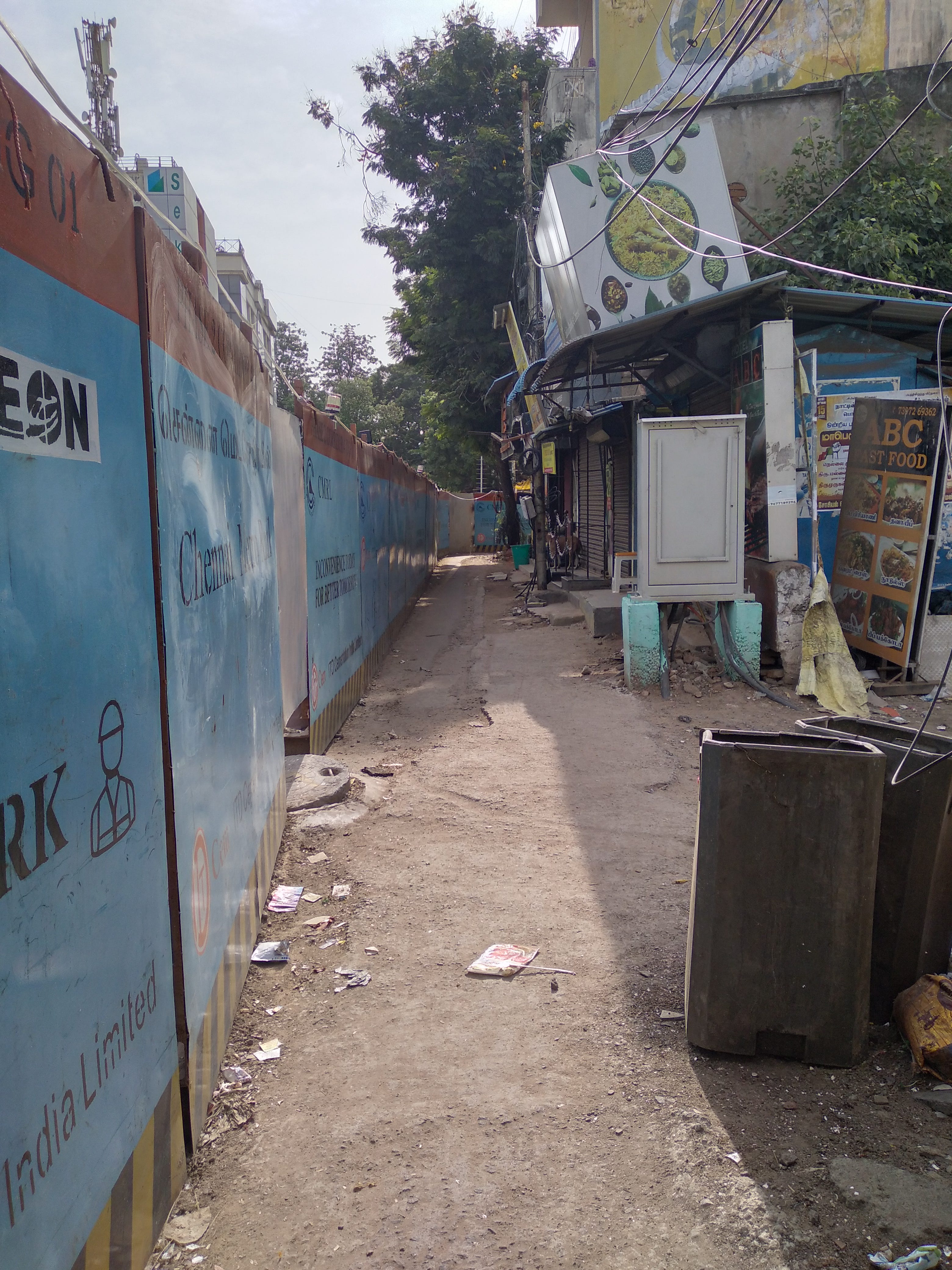
As cities become more and more congested with growing rural migration, rising population levels and pre-emptive construction, space becomes less and less. Metro stations are built above roads as elevated tracks, or underground with only the metro entrance peeping out. Decisions are taken based on congestion of regions, and battles are fought by residents to prevent their removal. In this photo below is metro work taking place on a road in Chennai. In order to build underground, traffic is diverted and shops squeezed into narrow sub-lanes. In this case, the road will be returned, with a few additions, and a few buildings altered.
But in this demand for faster connectivity, the commons are regular targets: In Chennai, large protests took place to protect Shenoy nagar park and there was disgruntlement when the metro was rumoured to have proposed taking parts of the Theosophical Society’s main road frontage to built a station (this is not the case today - the metro is being built on the road a little distance away).
Class politics always plays its hand, and while Shenoy Nagar park and the green of theosophical society get a voice, no one talks about the park that I passed on the bus, north of the Adayar bridge from the Theosophical society, where children who played there were from across the board - but primarily non-elite families.
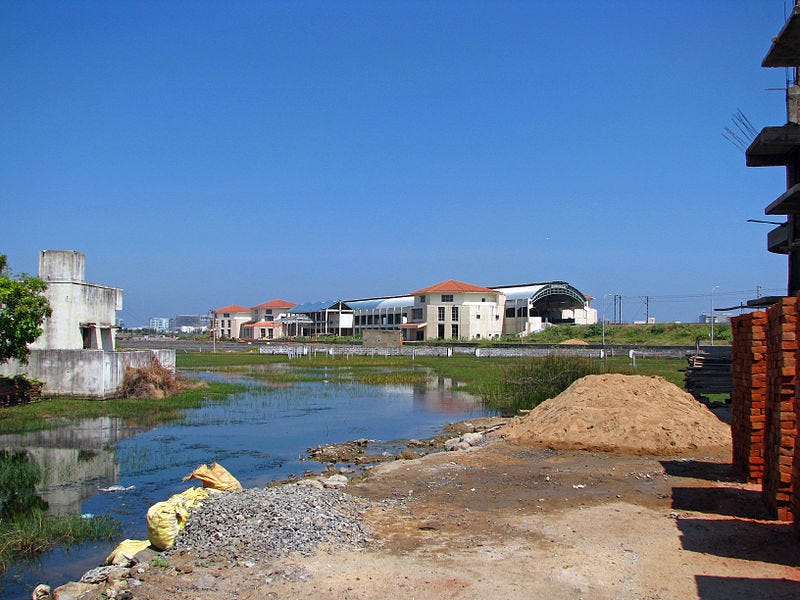
Governments routinely re-label land usage, turning lakes and marshes into real-estate that everyone builds on. Is a marsh a commons? Of course it is, I would say. The Pallikaranai marsh was one of Chennai’s largest (and the cover photo of this piece). While it may not be ‘economically’ beneficial for all, it is definitely an aquefer zone that in a city like Chennai, prevents all our houses from flooding — as happens now with increased rates of construction.
Ecologically, the Pallikaranai marshland holds space for migrating birds, fishes - and even reptiles, like the crocodiles that are occasionally found there. The marsh’s land has also been given out to various organisations to establish themselves. In the image above, look closely and you’ll see retail spaces, residential spaces, telephone lines and roads. The Pallikaranai marsh is also partly a garbage dump. Where garbage was initially dumped in Kodungaiyur north of the city, as more construction reduced ‘poromboke’ and open land areas, the Pallikaranai marsh became a dumping ground.
In Tamil, the term ‘Poromboke’ refers to land that is owned by none. Attached here is a song by TM Krishna, on the poromboke. The song was written for the Ennore creek, an environmentally sensitive region but used for industries as cooling water and to dump effluents. A port by Adani has been proposed there. Poromboke land, claimed for development practices, hurt the ecology and local livelihood of the place. As the song suggests, Commons are more than just what people use: they are inter-species use spaces at times, like marshes.
Lakes are often divided by highways, where the smaller segment is eaten into and the larger one protected in a weird ‘divide and conquer’ of the urban landscape, the common (attach google earth images). Low-income areas are given pattas to land adjoining these water bodies, as are tall middle-class apartments. When environment groups protest, it is these homes that are the first to go, while the apartments stay. In Saidapet, a twenty-storey apartment building was constructed after the eviction of a slum removed ostensibly for their own safety after they were affected by the Adayar river during the 2015 floods.
It turns out even coastlines aren’t immune: a report by Citizen Matters in August this year highlighted the fact that there were plans to ‘develop’ Chennai’s coastline: a move that could displace the fishing communities on the coast.
Cities have become the focal point of developmental and economic activity. From migration for work, to establishment of business and government, the city is where ‘it’ is at today. Cities promise comfort, connections and socialisations, and a place to call home. In the process, those who control the growth of the city today, choose to claim its common spaces in order to better it, but in the process, capitalistic forces segmentarise cities (see Asher Ghertner’s study of Delhi ‘Rule by Aesthetics’ on how the city is claimed by a few for themselves, and Edward Glaeser’s ‘Triumph of the City’ in order to see this seizure contextualised from the point of view of US history).
In this age of burgeoning cities, our common spaces are the most vulnerable. Gentrification is a process that has reached every megacity around the world. The seizing of our commons goes as we watch, turning spaces of public enjoyment into areas of financial benefit or of garbage dumping and individual houses.